
WHICH FACE IS AI?
Which face is AI? Look beyond first impressions
AI portraits can look completely photographic at first glance. The useful clues are often small relationships between facial detail, lighting, hair, accessories and the background rather than one obviously broken feature.
A repeatable method
Don't guess from one clue. Inspect in layers.
The most useful skill is not memorizing yesterday's AI mistakes. It is learning where several parts of an image must agree with each other.
1. Read the whole image
Start at normal size. Ask whether the scene, expression, lighting and camera feel belong together before hunting for tiny defects.
2. Zoom into high-information areas
Eyes, hair edges, teeth, glasses, fingers, reflections and contact points force many visual relationships to agree at once.
3. Compare, don't stereotype
One smooth cheek or unusual tooth proves very little. Compare several independent clues and look for contradictions.
4. Make a weighted decision
Give more weight to structural inconsistencies than to vague 'AI vibes'. Modern generated images can be extremely convincing.
Visual field guide
Where to look — and why it matters
These are comparison zones, not automatic proof. A strong judgement usually comes from several clues pointing in the same direction.
Eyes and catchlights
Compare eye shape, iris detail, eyelids and reflected light. Both eyes should make sense under the same lighting and perspective.
Hair and facial edges
Inspect loose strands around the forehead, ears and cheeks. Hair is complex and can expose subtle merging or inconsistent boundaries.
Teeth, lips and mouth
Fine dental spacing, lip texture and the transition between teeth, gums and shadows can reveal generation artifacts.
Skin and asymmetry
Real faces contain pores, marks and natural asymmetry. AI faces can be extremely convincing, so compare local texture rather than relying on one stereotypical clue.
Visual lesson · Faces
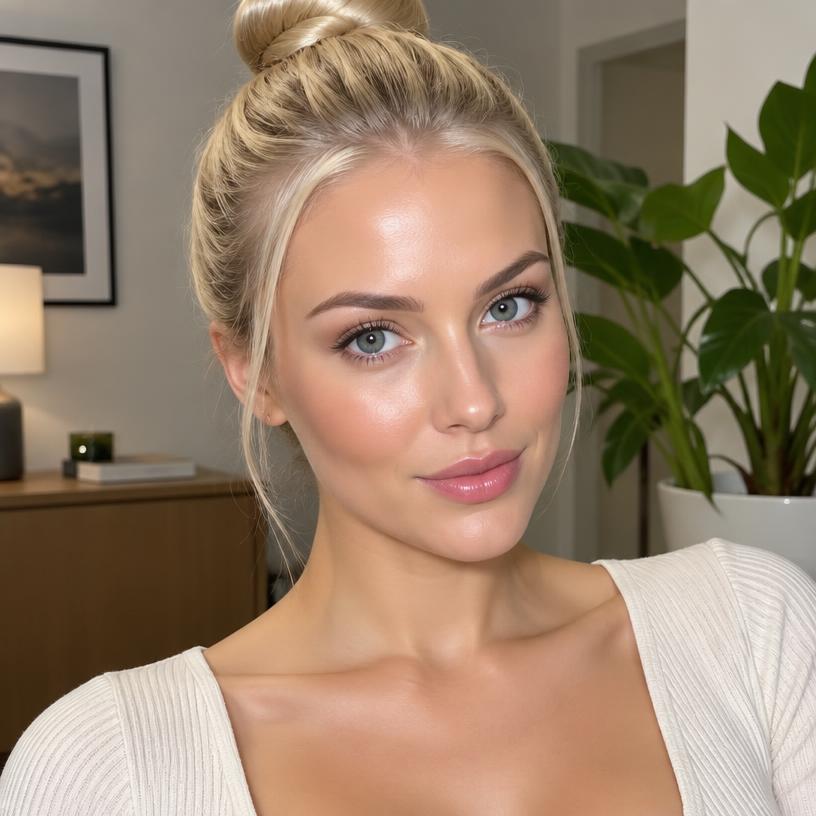
Close-up skin, eyes and hair
Do not choose from ‘perfect skin’ alone. Compare how pores, eyelids, catchlights and fine hair behave together across the whole face.
The numbered markers correspond directly to the numbered explanations below.
 A123
 B123
Eyes and eyelids
Marker 1 is placed directly on the eye area. Compare iris detail, catchlights, eyelid edges and lashes in both portraits.
Cheek skin texture
Marker 2 is placed on an exposed cheek area. Compare pores, fine lines, local sharpness and whether texture changes naturally across the skin.
Hair-to-skin edge
Marker 3 is placed where hair meets the face or background. Compare fine strands, edge transitions and whether the boundary stays structurally coherent.
Takeaway: The useful question is not which face looks more perfect. It is which image stays physically and photographically coherent when you compare several specific areas at once.
Strong clues
Several independent inconsistencies that reinforce each other: geometry, lighting, reflections, anatomy, contact points or local texture that does not fit the same camera and scene.
Weak clues
“Too perfect”, smooth skin, dramatic lighting or one odd feature. Real photography, retouching, compression and portrait mode can create all of these too.
Start with symmetry, but do not expect perfection
Real faces are naturally asymmetric. Eyebrows sit at slightly different heights, smiles pull unevenly and skin texture varies from one side to the other. Generated faces may also be asymmetric, so perfect symmetry is not a reliable rule by itself.
Instead, compare whether asymmetry feels physically connected. A real expression changes cheeks, eyes, lips and wrinkles together. Generated portraits can occasionally create features that look individually plausible but do not quite agree with the same expression or head angle.
Hair, ears and accessories carry a lot of information
Hair contains thousands of thin overlapping structures. Pay attention to where strands cross ears, glasses, hats and the background. Look for local merging, abrupt texture changes or strands that lose physical continuity.
Accessories create similar challenges. Earrings should attach correctly, glasses should preserve consistent frame geometry across the face, and reflections in lenses should agree with the scene lighting.
Skin texture is useful only in context
AI portraits are often described as too smooth, but real portrait photography can also use soft light, beauty filters and skin retouching. The stronger question is whether pores, freckles, fine lines and surface detail vary naturally across the face and match the sharpness of nearby features.
Compare the skin with hair, eyelashes and clothing. If one material has extremely crisp micro-detail while another at the same focal distance looks strangely synthetic or uniform, that mismatch may matter more than smoothness itself.
Remember
A visual clue is evidence — not proof.
A real photo can contain blur, strange teeth, aggressive sharpening, beauty filters or broken-looking edges. An AI image can be almost flawless. Confidence should rise when several independent details fail in a consistent way, not because one feature looks unusual.
Frequently asked questions
What facial feature gives AI away most often?
There is no universal feature. Hair boundaries, eyes, teeth, ears, glasses and skin transitions are all useful because they combine fine geometry with texture and lighting.
Are AI faces always too attractive or too perfect?
No. Modern generators can create ordinary-looking faces, age variation, skin imperfections and documentary-style photography. Appearance alone is weak evidence.
Why are AI faces so difficult now?
Portrait generation has improved dramatically, and faces have been a major focus of generative-image research and products. Many older visual shortcuts no longer work consistently.
Train your eye instead of memorizing rules
FaceOrBot gives immediate feedback after every choice and explains what was worth inspecting. That makes each round a short visual lesson rather than just a score.